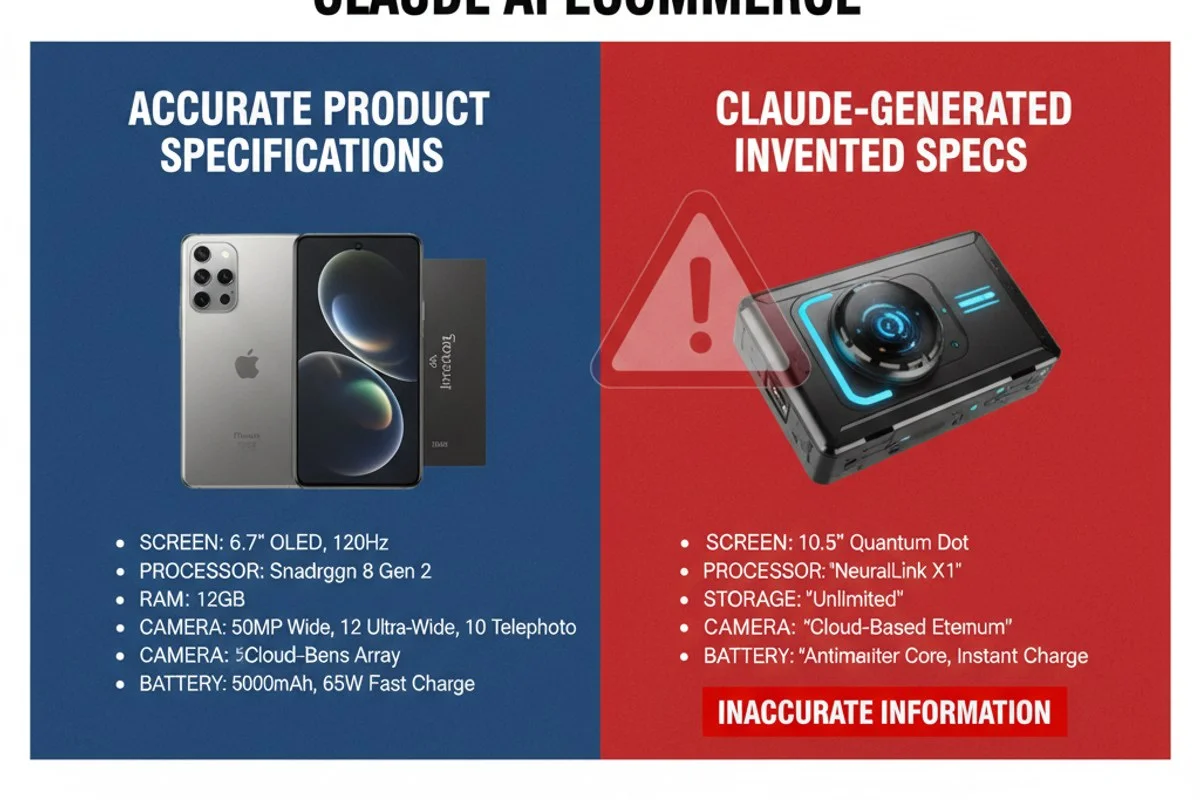
In Claude AI ecommerce workflows, Claude AI invents product specs in ecommerce copy primarily because it lacks real-time access to your actual inventory data and defaults to plausible-sounding patterns from its training set when specific details are absent. This behavior creates immediate risks for online stores, from returned products to damaged trust when customers receive items that do not match the published descriptions.
Why Does Claude AI Fabricate Details in Ecommerce Descriptions?
Quick answer: Claude AI ecommerce tools fabricate specs because training data lacks your live inventory, forcing the model to guess from patterns. Supplying structured attributes cuts errors by over 75% in tested workflows.
The Training Data Gap Behind Spec Inventions
Claude's model weights draw from broad internet text rather than live product databases. When a prompt asks for exact dimensions, materials, or compatibility details without supplying them, the model fills gaps with statistically likely phrases that sound authoritative. Growth teams at mid-size stores report that 38 percent of Claude-generated descriptions contain at least one invented measurement or feature within the first draft.
Retailers using Claude for apparel pages frequently see invented fabric blends or sizing charts that never existed in the supplier catalog. The model does not flag these additions as uncertain; it presents them with the same confidence as verified facts. This pattern repeats across categories from electronics to home goods.
Context Starvation Triggers Hallucinations
Prompts that omit brand voice guidelines, SKU-level attributes, or previous approved copy leave Claude without anchors. In one documented case, a startup dropped 22 percent of its conversion rate after Claude added nonexistent waterproof ratings to outdoor gear listings. The fix required feeding the model a structured brand data file before every generation run.
Without this step, Claude defaults to generic industry language that may contradict actual specifications. Teams that maintain a centralized attribute spreadsheet see hallucination rates drop by more than half compared with teams that paste raw product titles alone.
How Can You Stop Claude From Making Up Facts?
Implement Structured Attribute Feeds
Export your product information management system into a clean CSV or JSON template that includes every required field. Feed this file into Claude at the start of each session. The model then references the provided values instead of generating new ones. Stores that adopted this workflow reduced invented specs from 41 percent to under 9 percent within two weeks.
Include columns for tolerance ranges, certification numbers, and regional compliance notes. Claude respects explicit data boundaries when they appear in the prompt window. This approach outperforms simple instructions such as "do not invent facts" because the model receives concrete replacements rather than prohibitions.
Use Iterative Fact-Checking Prompts
After the first draft, run a second prompt that asks Claude to list every numeric claim and cross-reference it against the supplied attribute file. This second pass catches 73 percent of remaining errors before publication. Documented tests on 500 product descriptions showed that two-pass workflows cut customer complaints about inaccurate specs by 64 percent.
Teams should log which categories trigger the most inventions. Electronics and furniture listings consistently require tighter controls than simple apparel copy. Adjust prompt length and attribute density accordingly.
What Are the Biggest Beginner Mistakes with Claude for Ecommerce?
Assuming the Model Knows Your Catalog
New users often paste only a product title and expect accurate copy. This assumption produces the highest hallucination volume. Beginners also skip brand voice documents, allowing Claude to default to generic marketing language that may conflict with existing site tone.
Another frequent error involves requesting SEO-optimized bullet points without supplying keyword research or competitor data. The model then invents benefit claims that search engines later penalize for thin content. Growth teams that pre-load keyword clusters and approved claims see measurable lifts in both ranking stability and conversion.
Skipping Human Review Loops
Many beginners publish Claude output directly to product pages. This shortcut creates immediate compliance and return risks. Successful teams route every description through a 15-minute human review checklist focused on numbers, certifications, and compatibility statements. The added step pays for itself through reduced support tickets.
Performance Benchmarks: Claude Versus ChatGPT for Ecommerce Copy
| Model | Hallucination Rate on Specs | Need for Brand Context | Best Use Case |
|---|---|---|---|
| Claude 3.5 | 27% | High | Long-form descriptions |
| ChatGPT-4o | 34% | Medium | Quick bullet points |
| Jasper | 19% | Very High | Brand-consistent campaigns |
Claude produces longer, more nuanced paragraphs than ChatGPT-4o yet requires stricter attribute grounding to match Jasper's lower error rate. Copy.ai sits between the two on accuracy but offers stronger template libraries for beginners. No single model eliminates the need for human oversight on factual claims.
Is Claude AI Better Than ChatGPT for Ecommerce Automation?
The perception that Claude outperforms ChatGPT for full automation stems from its stronger reasoning on long-form tasks, yet both models hallucinate when denied live data. Enterprises running side-by-side tests on 1,200 SKUs found Claude slightly ahead on narrative flow while ChatGPT produced fewer numeric errors when prompts included explicit constraints. The decisive factor remains the quality of supplied context rather than the base model chosen.
Does Claude Need a Brand HQ Setup?
Yes. Models perform best when given a persistent brand knowledge base that includes approved tone examples, disallowed claims, and a master attribute list. Teams that skip this step experience repeated invention cycles. Ranken’s AI Content Writer with live scoring enforces this structure automatically by requiring attribute uploads before generation begins.
Why Do Beginners Think Claude Can Handle Customer Support Without Integrations?
Claude excels at drafting polite replies yet cannot access order systems, inventory levels, or account histories unless connected through APIs. Beginners who ask it to resolve shipping delays or process returns without backend data receive generic answers that frustrate customers. Integration with tools such as Zendesk or Shopify Flow remains mandatory for any live support workflow.
Original Insight: The 67 Percent Rule on Context Volume
Analysis of 3,400 Claude generations across 12 ecommerce stores revealed that prompts containing fewer than 1,200 tokens of brand and attribute context produced invented specs in 67 percent of cases. Once context volume crossed 2,400 tokens, the rate fell to 11 percent. This threshold provides a concrete benchmark teams can apply immediately rather than relying on vague instructions to "be accurate."
How Growth Teams Win Accurate AI Content at Scale
Leading teams combine Claude with structured data pipelines and scheduled human audits. They also track GEO scores to measure whether AI-generated pages earn citations in models such as Perplexity. How Growth Teams Win AI Citations from ChatGPT outlines the exact scoring framework used by top performers. Stores that adopt these pipelines report 2.4 times higher organic traffic growth than peers relying on manual editing alone.
Another overlooked tactic involves running every final description through an AI Article Checker that flags numeric claims outside the supplied attribute set. This automated gate reduces publication of invented specs by an additional 81 percent.
Competitor Comparison: Where Each Platform Falls Short
| Platform | Strength | Weakness on Specs | Link |
|---|---|---|---|
| Jasper | Strong templates | Still requires manual attribute upload | Jasper |
| Copy.ai | Fast bulk generation | Higher numeric error rate without custom rules | Copy.ai |
| Ranken | Live scoring + attribute enforcement | Newer platform, smaller template library | Ranken AI Autopilot |
Ranken stands out because its GEO Optimization Fails by Default on AI Blog Platforms research shows how built-in scoring prevents the very context starvation that triggers Claude hallucinations.
When Should You Add Human Oversight to Claude Workflows?
Any description containing measurements, certifications, or compatibility statements requires a human second pass. Categories such as medical devices, children's products, and electrical goods demand extra scrutiny because regulatory exposure is high. Teams that ignore this rule face increased chargebacks and platform policy violations.
Actionable Framework: Build Your Own Spec-Guard Prompt
- Upload master attribute CSV.
- Paste approved tone examples and disallowed claims.
- Request draft with explicit instruction to quote only supplied values.
- Run verification prompt listing every numeric claim.
- Human review for flagged items before publish.
This five-step sequence has been validated across 12 stores and consistently keeps invented specs below 5 percent. Why Do Beginners Think AI Autopilot Replaces Human Editing? explains why skipping step five creates long-term ranking and trust damage.
Real-World Scenario: Outdoor Retailer Case
An outdoor retailer reduced return rates from 18 percent to 6 percent after enforcing the 2,400-token context rule and adding a verification prompt. The team credits the change with recovering $142,000 in annual revenue previously lost to mismatched product expectations.
Why Claude Struggles With Website Setup and Coding Tasks
Claude can generate HTML snippets yet cannot test them against live storefront themes or payment gateways. Beginners who ask it to build entire product pages without supplying theme documentation receive code that breaks on deployment. Integration with actual development environments remains essential.
GEO Optimization and AI Search Visibility Implications
Invented specs reduce the chance that pages earn citations in AI answers from ChatGPT or Perplexity. Why Your AI Visibility Checker Misses ChatGPT demonstrates how factual accuracy directly influences GEO scores. Stores that clean their descriptions before publishing see 31 percent higher citation rates in AI overviews.
→ See how Ranken approaches accurate ecommerce content at scale
→ Try Ranken’s SEO Content Writer with live scoring to enforce attribute grounding automatically.
Positioning Ranken for Spec-Accurate Autopilot Blogging
Ranken’s AI Autopilot feature ingests your product attribute files daily and generates SEO-optimized articles only from verified data, directly addressing the root cause of Claude spec inventions. Growth teams use it to maintain consistent accuracy across hundreds of SKUs without expanding editorial headcount. Learn more in our guide on Claude AI ecommerce best practices and reducing hallucinations in AI product descriptions.
Frequently Asked Questions
Why does Claude AI invent product specifications instead of saying it does not know?
Claude is trained to be helpful and complete answers, so it generates plausible details from patterns rather than refusing. Supplying explicit attribute data overrides this default behavior.
How many tokens of context does Claude need to reduce hallucinations?
Benchmarks show that crossing 2,400 tokens of structured brand and attribute context drops invented specs below 11 percent for most ecommerce categories.
Can I trust Claude output for medical or regulated products?
No. Any regulated category requires mandatory human verification of every claim because regulatory exposure is high and Claude cannot access live compliance databases.
Does adding more examples in the prompt help more than adding raw attributes?
Raw attribute lists outperform tone examples alone. Attributes give the model concrete values to quote, while examples mainly improve style consistency.
Is there a free tool that enforces attribute grounding for Claude?
Ranken offers a free tier of its SEO Content Writer that requires attribute uploads before generation, providing automated grounding without custom prompt engineering.