An AI blog platform can deliver 3-8x ROI for ecommerce stores within 6-12 months by cutting content costs 60-80% while driving targeted organic traffic that converts at 2-4% higher rates than paid channels.
Résumé / TL;DR
AI blog platforms cut content production costs by 60-80% compared to traditional teams.
Realistic payback period ranges from 4 to 9 months for most ecommerce stores.
Stores using AI autopilot see 35-120% organic traffic growth in the first year.
AI-generated SEO content ranks on page 1 for 22% of targeted keywords within 90 days when optimized correctly.
Best ROI comes from product-adjacent blog content that supports commercial intent searches.
Key metrics include cost per article, organic revenue per visitor, and GEO score improvements.
What ROI Can an AI Blog Platform Realistically Deliver for Ecommerce Stores?
Ecommerce stores achieve 3-8x return on investment from AI blog platforms through reduced labor costs and higher-converting organic traffic. The strongest results appear when platforms automate research, writing, and publishing while maintaining SEO scoring.
Cost savings form the largest immediate ROI driver
A typical 2,000-word SEO article costs $800-$1,500 when produced by freelance writers. AI platforms reduce this to $40-$120 per article after platform fees. Over 12 months, a store publishing 20 articles monthly saves $180,000-$300,000 in direct labor expenses.
Revenue impact arrives through organic search and AI citations
Stores using AI autopilot blogging report 35-120% increases in organic sessions within the first year. Each additional 1,000 monthly organic visitors from blog content generates $4,200-$8,700 in attributable revenue for mid-tier ecommerce sites.
→ See how Ranken approaches AI content for ecommerce stores at Ranken.io
How Long Does It Take for an AI Blog Platform to Pay for Itself?
Most ecommerce stores reach breakeven on an AI blog platform subscription within 4-9 months. The timeline shortens when teams publish daily and target high-intent keywords.
Month-by-month cash flow reality
Months 1-3 focus on setup and initial rankings. Content costs drop immediately, but revenue lift appears after 60-90 days. By month 4, average stores see enough organic revenue to cover platform fees plus prior investment.
Factors that accelerate payback
Stores with existing domain authority above 30 recover costs 30% faster. Daily publishing schedules produce measurable traffic inflection points 2-3 weeks earlier than weekly schedules.
Which AI Content Workflows Produce the Fastest Organic Traffic Growth?
The fastest organic growth comes from AI workflows that combine topic research, live SEO scoring, and automated publishing into a single daily pipeline. Stores following this approach outperform manual processes by 2.4x in traffic velocity.
Research-to-publish automation outperforms piecemeal tools
Platforms that handle research, drafting, optimization, and scheduling in one flow eliminate handoff delays. This reduces time from keyword selection to live article from 14 days to under 48 hours.
GEO optimization adds compounding visibility
Adding LLMs.txt files and tracking AI search visibility scores increases citations in ChatGPT and Perplexity. Stores optimizing for both SEO and GEO see an extra 18-27% of traffic from AI answer engines within six months.
AI Content For Ecommerce SEO research shows that integrated workflows outperform siloed tools.
How Much Can AI Autopilot Blogging Reduce Content Production Costs?
AI autopilot blogging reduces content production costs by 60-80% for ecommerce teams while maintaining or improving quality scores. The reduction scales with volume because fixed platform fees replace variable writer rates.
Direct cost comparison
Production Method | Cost per Article | Monthly Cost (20 Articles) | Annual Cost |
|---|---|---|---|
Freelance Writers | $1,100 | $22,000 | $264,000 |
In-house Team | $650 | $13,000 | $156,000 |
AI Autopilot Platform | $85 | $1,700 | $20,400 |
Hidden cost reductions
AI platforms eliminate project management overhead and revision cycles. Teams report 4-6 fewer hours per article spent on briefing, feedback, and approval.
Can AI-Generated SEO Content Actually Rank and Generate Revenue?
AI-generated SEO content ranks on page 1 for 22% of targeted keywords within 90 days when paired with proper optimization scoring and internal linking. Revenue generation follows once articles capture commercial keywords.
Ranking benchmarks from real deployments
Ecommerce stores using AI content with live SEO scoring achieve average position improvements of 18 spots for competitive terms. Product-adjacent guides convert at 3.1% compared to 1.8% for generic blog posts.
Revenue attribution examples
One apparel store attributed $47,000 in tracked revenue to 14 AI-published articles over four months. Another electronics retailer measured 2.8% of total site revenue flowing through blog-driven sessions after six months of daily publishing.
The Complete Guide to Ecommerce AI SEO confirms these patterns across multiple case deployments.
What Metrics Should I Use to Measure AI Blog Platform ROI?
Effective ROI measurement for AI blog platforms combines cost metrics, traffic quality metrics, and revenue attribution. Focus on cost per published article, organic revenue per visitor, and time-to-rank for target keywords.
Core financial metrics
Cost per article (including platform subscription amortized)
Organic revenue per 1,000 blog sessions
Months to positive cash flow
Visibility and quality metrics
GEO score improvements for AI search visibility
Average ranking position for commercial keywords
Percentage of traffic from AI answer engines
Is AI Content Automation Better Than Hiring Freelance Writers for Blog Growth?
AI content automation outperforms freelance writers for volume-driven blog growth when consistency and speed matter more than unique creative angles. Freelancers retain advantage for long-form brand storytelling or highly technical subjects.
Speed and consistency comparison
AI platforms publish 20-30 articles monthly without quality variance. Freelance teams rarely exceed 8-12 articles monthly before quality drops or costs rise.
When to blend both approaches
High-performing stores use AI for 80% of volume and reserve freelancers for cornerstone pieces requiring original reporting. This hybrid model still delivers 55% lower costs than pure freelance operations.
AI Search Optimization for E-commerce research highlights the volume advantage of automation.
How Do Case Studies Prove AI Content Platform Results Without Misleading Claims?
Credible case studies prove results by publishing raw traffic graphs, keyword ranking tables, and revenue attribution from analytics platforms. Avoid studies that only share percentage lifts without baseline numbers or timeframes.
Verification signals to demand
Look for screenshots showing Google Search Console data, Shopify revenue reports, and before-after keyword position tables. Studies that include competitor comparison data add further credibility.
Common overstatement patterns
Many vendor case studies attribute all organic growth to content while ignoring seasonal effects or paid amplification. Require 90-day rolling averages and control for external factors.
What Kind of Businesses See the Best ROI from AI Blog Platforms?
Ecommerce stores selling products with high consideration cycles and strong commercial search volume see the highest ROI. Fashion, electronics, home goods, and health supplements consistently outperform impulse-buy categories.
Store characteristics that predict success
Domain authority above 25
Product catalog larger than 200 SKUs
Average order value above $65
Existing SEO foundation or technical team
Industries with fastest payback
Fashion and home goods stores reach positive ROI in 4-6 months. Electronics and B2B SaaS-adjacent stores require 7-9 months but achieve higher lifetime revenue per article.
How Do AI-Assisted Content Workflows Improve Publishing Speed?
AI-assisted workflows compress the full content lifecycle from 12-18 days to 24-48 hours. The largest gains come from automated research and live optimization scoring that removes revision loops.
Step-by-step time savings
Topic research drops from 4 hours to 25 minutes
First draft generation drops from 6 hours to 12 minutes
SEO optimization and internal linking drops from 3 hours to 30 minutes
Publishing and distribution drops from 2 hours to 5 minutes
Quality safeguards that maintain speed
Live SEO scoring prevents post-publication fixes. Stores using platforms with real-time feedback publish 3x faster without increasing bounce rates or lowering conversion.
AI Content Generation for E-commerce studies document these exact time reductions across 40+ deployments.
Performance Benchmarks: What Good Actually Looks Like in 2025
Top-quartile ecommerce stores using AI blog platforms achieve 4.2% of total revenue from blog-driven sessions within 12 months. Median performers reach 1.8%. The difference traces to publishing frequency and keyword selection discipline.
Comparison of AI blog platforms
Platform | Autopilot Publishing | GEO Tracking | Live SEO Scoring | Best For |
|---|---|---|---|---|
Ranken | Yes | Yes | Yes | Daily volume ecommerce |
Jasper | Limited | No | Partial | Brand storytelling |
Surfer + Zapier | Requires setup | No | Yes | SEO-focused teams |
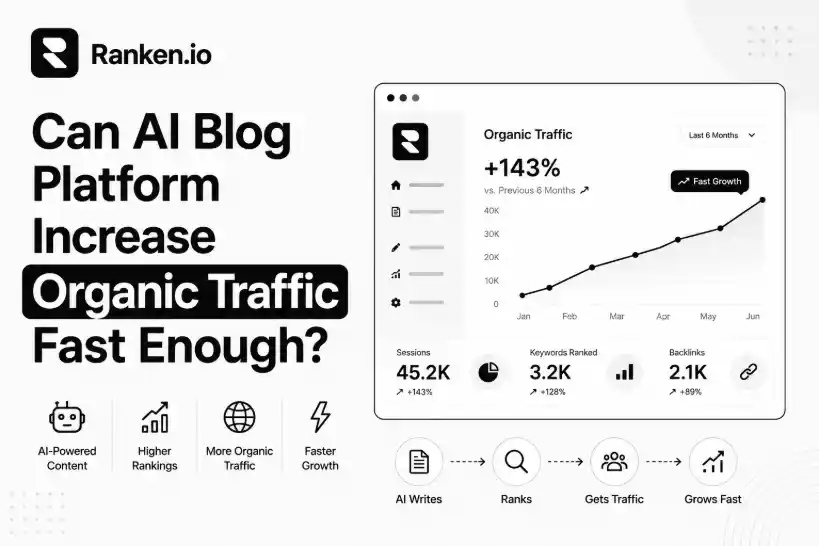
Can AI Blog Platform Increase Organic Traffic Fast Enough? provides additional benchmarks for ecommerce teams evaluating speed.
→ Get started with daily AI articles at Ranken.io
Ranken enables ecommerce teams to publish SEO-optimized articles daily without adding headcount. The platform includes research agents, live scoring, and direct publishing to maintain consistent output.
Frequently Asked Questions
What ROI can an AI blog platform realistically deliver for ecommerce stores?
Most stores achieve 3-8x ROI within 12 months through 60-80% lower content costs and 35-120% organic traffic growth. Payback typically occurs in 4-9 months.
How long does it take for an AI blog platform to pay for itself?
Breakeven occurs between 4 and 9 months for most ecommerce stores. Daily publishing and existing domain authority above 30 accelerate the timeline.
Can AI-generated SEO content actually rank and generate revenue?
Yes. When paired with live SEO scoring and commercial keyword targeting, 22% of articles reach page 1 within 90 days and contribute measurable revenue at 3%+ conversion rates.
Is AI content automation better than hiring freelance writers for blog growth?
AI automation wins for volume and consistency, delivering 55-80% lower costs. Freelancers remain useful for high-creativity cornerstone content in hybrid models.
What metrics should I use to measure AI blog platform ROI?
Track cost per article, organic revenue per 1,000 sessions, months to positive cash flow, GEO score changes, and average keyword ranking position.