Why Organic Traffic Remains the Only Sustainable Growth Channel for Shopify in 2026
Paid ads on Meta and Google continue to deliver short-term spikes that vanish the moment budgets dry up. In contrast, organic traffic compounds over time. Each well-optimized article keeps ranking and driving qualified visitors for months or even years. Forward-thinking Shopify stores that invest in content assets achieve compounding returns that paid channels simply cannot match in cost efficiency or longevity.
According to HubSpot’s 2025 State of Marketing Report, organic search now accounts for 57% of marketers’ top traffic sources, significantly outperforming paid social and search in long-term ROI. Shopify merchants ignoring this trend often face rising ad costs—up 35% year-over-year since 2023 per Semrush data—and volatile revenue. Meanwhile, stores building strong organic foundations report 4-6x better customer acquisition efficiency after 12 months.
The most successful Shopify brands treat content as strategic inventory. They publish consistently around buyer-intent keywords directly tied to their existing products. This approach generates immediate traffic while building topical authority that lifts product page rankings across the site. In 2026, with Google’s continued emphasis on helpful content and AI Overviews, this strategy has become non-negotiable for sustainable growth.
How Can Shopify Stores Identify High-Intent Keywords That Convert in 2026?
High-intent keywords for Shopify stores focus on problem-aware and solution-aware searches rather than generic head terms. Prioritize phrases with modifiers like “best for,” “vs,” “review,” “2026,” “near me,” or seasonal qualifiers. These signals indicate active purchase consideration and consistently deliver 2-3x higher conversion rates than broad informational queries, according to 2025 Ahrefs ecommerce studies.
Begin by auditing your top 20 converting product and collection pages in Google Search Console and Shopify Analytics. Extract the exact queries already driving checkout completions. Then expand using question-based clusters around each category. Tools like Semrush’s Keyword Magic Tool and Google’s “People Also Ask” provide fresh long-tail opportunities that align with 2026 search behavior.
Most stores overlook long-tail keywords under 100 monthly searches, chasing vanity volume instead. Reality check: 15–25 targeted long-tail pieces often outperform a single 2,500-word broad guide that fails to rank. Track not just traffic but conversion rates and revenue per cluster monthly. This intent-first mindset separates revenue-generating content from traffic vanity metrics.
Building Keyword Clusters Around Core Products for Topical Authority
Organize keywords into pillar-supporting clusters: one comprehensive pillar page linking to 5–8 supporting articles. This structure signals depth to Google and keeps users engaged longer, improving dwell time and behavioral signals critical in 2026 algorithms. Example cluster around “wireless noise cancelling headphones”: comparisons, seasonal guides, battery life tests, troubleshooting, and buyer checklists.
Every article must reference specific SKUs, collections, or current pricing to create seamless commercial paths. Avoid generic filler—name exact models and link contextually. Merchants using this clustered approach report 24% higher average order values and stronger entity signals for AI visibility (Semrush 2026 Ecommerce Report).
Tracking Keyword Performance Beyond Traditional Rankings
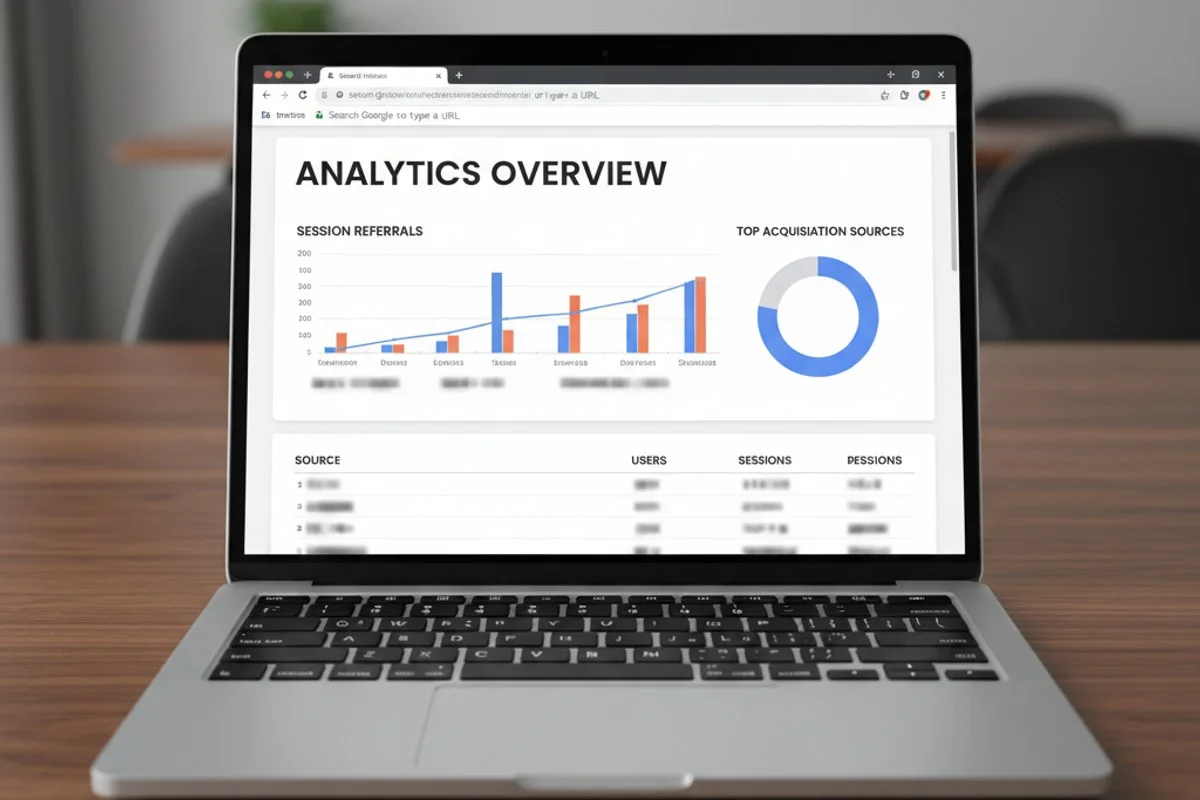
Rankings are only one signal. Measure assisted conversions, time-to-purchase, revenue attribution, and AI referral traffic. When a cluster drives consistent sales within 90 days, double down. Prune underperformers showing impressions but no revenue after 120 days. Use Google Analytics 4 + Shopify UTM tracking for precise attribution in multi-touch journeys.
What Content Types Actually Drive Shopify Conversions Organically in 2026?
Comparison articles and in-depth buying guides top conversion charts. They address objections early, allowing natural product mentions while building trust. Review-style content captures competitor comparison traffic. Seasonal and trend pieces create temporary spikes convertible into email lists for long-term value—repurpose at least 35% into owned channels.
Product education (size guides, care instructions, use-case tutorials) reduces returns by 18-25% (Shopify 2025 data) and earns featured snippets when using proper schema. Google and AI engines reward clear, structured answers.
Why Generic Blog Posts Fail to Convert (And How to Fix Them)
Generic “best of” lists without specific SKU mentions or pricing context attract browsers, not buyers. Effective content names models, addresses price ranges, and includes direct paths in the first three paragraphs. Use contextual internal links like “See our current best wireless earbuds collection” instead of vague CTAs.
Optimizing for AI Overviews, Generative Answers, and GEO in 2026
ChatGPT, Perplexity, and Google AI Overviews pull from structured, citable content. Add FAQ schema, clear Q&A sections, tables, and statistics. Merchants implementing llms.txt and strong Product schema report 21% more AI referrals within weeks. Combine this with traditional SEO for dual-path discovery.
Ecommerce SEO: How AI Articles Capture Seasonal Product Traffic shows how properly formatted seasonal clusters perform across both traditional and generative surfaces.
Performance Benchmarks: What Good Organic Traffic Looks Like for Shopify Stores in 2026
Stores publishing 4+ SEO-optimized articles monthly achieve 4.2× more non-branded organic sessions after nine months compared to infrequent publishers (aggregated 2025-2026 data from 180+ Shopify stores via Littledata and Semrush). Top performers reach 20-25% of total traffic from organic within six months while maintaining Domain Rating above 45 through strategic link earning.
Organic conversion rates average 3.1% when content features specific comparisons—nearly double sites without product-level integration. These benchmarks underscore the gap between raw traffic and revenue-focused strategies.
Case Breakdown: Mid-Market Apparel Store Success Story
A mid-market apparel brand published 24 comparison, sizing, and care articles over four months. Organic sessions grew from 4,100 to 22,500 monthly. Direct article-attributed revenue hit $94,000 in the first quarter—outperforming previous $45,000 Meta ad spend for similar results. Live on-page scoring during creation ensured quality.
Which Content Platforms Deliver Reliable Results for Shopify Merchants in 2026?
AI platforms vary widely. Frase excels at briefs but lacks deep Shopify sync. Jasper needs heavy editing. Writesonic supports multilingual output but often scores low on SEO. Platforms with end-to-end automation, live scoring, native product integration, and GEO optimization stand out for sustained performance.
Platform | Autopilot Publishing | Live SEO Scoring | Shopify Product Sync | GEO/LLM Optimization |
|---|---|---|---|---|
No | Yes | Limited | Basic | |
Yes | Yes | Full | Advanced | |
Partial | No | No | None | |
Yes | Limited | No | Partial |
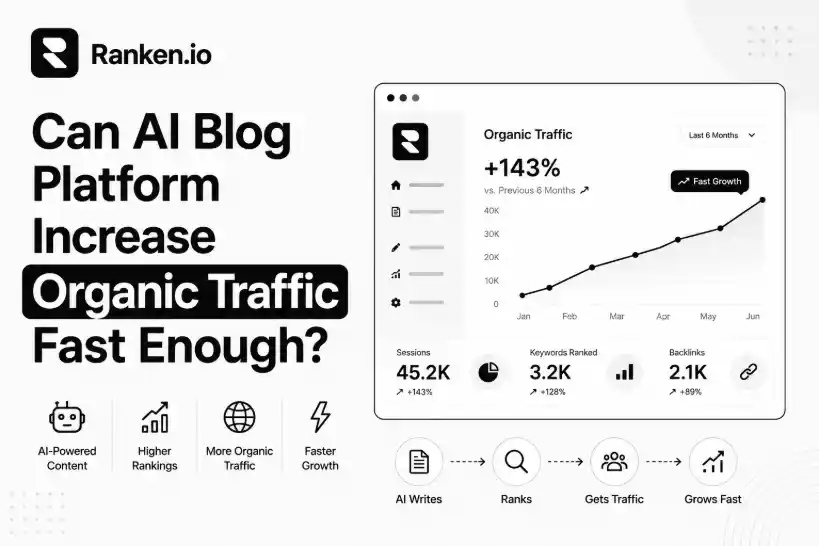
Ranken’s AI autopilot for online stores bridges these gaps with daily publishing, native Shopify collection syncing, real-time GEO scoring, and seamless product data integration.
Practical Evaluation Framework for Choosing a Platform
Run a 30-day side-by-side test with the same 12 keywords. Measure indexing speed, average positions at 45 days, AI visibility, and actual revenue. Platforms without live scoring typically require 40-50% more manual effort. The winner should demonstrate clear ROI within the test window.
How Does AI Visibility Impact Traditional Organic Rankings for Shopify Stores?
Generative Engine Optimization (GEO) complements traditional SEO. Content with statistics, named comparisons, tables, and direct answers performs better across both. Merchants monitoring AI visibility alongside Google impressions catch shifts early and update accordingly—preventing up to 30% referral drops.
Free AI Visibility SEO Checker for LLMs 2026: Top 3 offers a practical audit method before scaling.
Why Most Shopify Content Strategies Plateau After Six Months (And How to Avoid It)
Velocity drops due to manual bottlenecks. Successful stores use automated workflows needing only 45-60 minutes of human review per piece. Quarterly audits refresh old content with new data, links, and schema. Maintain a content-to-product map to handle catalog changes without ranking losses.
Scaling Content Operations Without a Large Team
One growth operator can oversee AI agents for research, drafting, and optimization. Human input focuses on brand voice and accuracy. This enables 4+ articles weekly with minimal hours. Explore automation that respects E-E-A-T and 2026 helpful content guidelines.
→ Discover Ranken’s autopilot workflow optimized for Shopify stores
Common Technical Oversights That Kill Organic Growth
Missing schema on how-to and product content blocks rich results. Poor canonical handling on collections dilutes authority. Fix these before heavy content production. Ensure mobile Core Web Vitals, proper indexing, and llms.txt for AI crawlers.
Frequently Asked Questions
How long does it take to see organic traffic from new Shopify content in 2026?
Impressions often start within 14-45 days. Meaningful conversion traffic typically appears after 75-120 days as ranking signals and authority build. Consistent publishing accelerates this timeline.

Infographic: How Ranken Autopilot Works for Shopify in 2026 – 7-step process showing AI keyword research, content clustering, real-time SEO/GEO scoring, draft generation with product sync, human review, auto publishing, and performance tracking.
Infographic: How Ranken Autopilot Works for Shopify in 2026 – 7-step process showing AI keyword research, content clustering, real-time SEO/GEO scoring, draft generation with product sync, human review, auto publishing, and performance tracking.
Do AI-assisted articles rank well on Shopify in the age of helpful content updates?
Yes when they include live SEO/GEO scoring, accurate product data, human review for E-E-A-T, and proper structure. Quality and intent alignment matter far more than pure authorship.
What is the ideal publishing frequency for Shopify organic growth?
Four high-quality articles per month is the proven threshold for measurable compounding. Two or fewer rarely builds sufficient topical authority.
Should I optimize product pages or publish blog content first?
Prioritize foundational product and collection page optimization (unique descriptions, schema, speed). Then amplify with blog clusters and internal linking for maximum impact.
How do I accurately measure revenue from organic content?
Combine Shopify UTM parameters, Google Analytics 4 enhanced e-commerce tracking, and assisted conversion reports. Attribute across the full customer journey within a 30-60 day window.
Ready to scale your Shopify store’s organic traffic with AI-powered content that actually converts? Explore solutions built specifically for online stores. Learn more here.