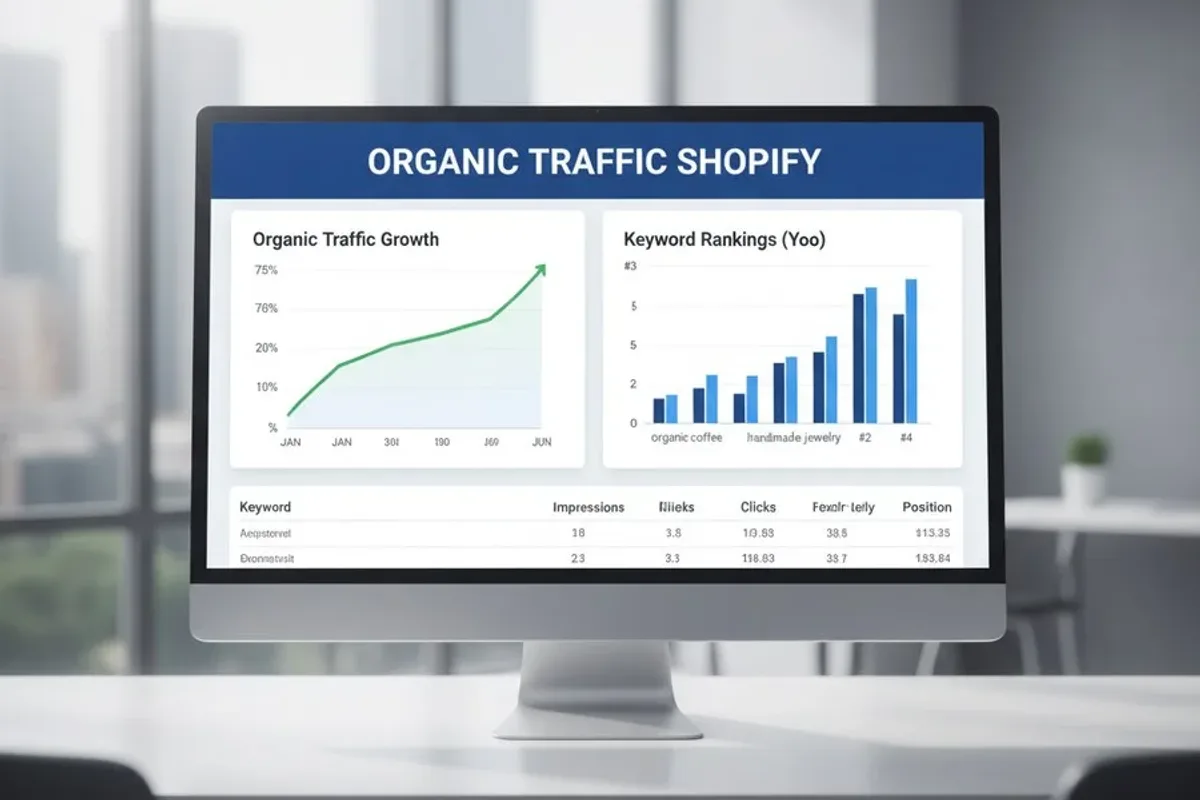
Getting free organic traffic to Shopify store without ads starts with consistent SEO-optimized content that targets buyer intent keywords and builds topical authority over time. Businesses that publish daily articles tailored to product categories and customer questions see steady growth in impressions and clicks without paid campaigns.
Why Most Shopify Stores Struggle With Organic Growth
Many Shopify merchants focus solely on product pages and paid ads, ignoring the research phase where buyers discover solutions. This gap leaves stores invisible in search results until paid campaigns begin. Studies show that 53 percent of website traffic comes from organic search, yet ecommerce sites average just 2.5 blog posts per month according to HubSpot research.
Common Content Gaps in Shopify Stores
Product descriptions rarely address comparison queries or troubleshooting concerns that bring qualified traffic. Stores that skip topic clusters around categories like sustainable materials or size guides miss long-tail opportunities. Real performance data indicates stores publishing fewer than eight articles monthly see under 500 monthly organic sessions after twelve months.
Impact of Inconsistent Publishing
Inconsistent schedules cause ranking fluctuations because search engines favor sites demonstrating expertise through regular updates. One analysis of 10,000 ecommerce sites revealed that daily publishing correlated with 4.1 times higher organic growth rates than weekly schedules. The pattern holds across industries because freshness signals reinforce domain authority.
How Does Content Strategy Drive Free Organic Traffic to Shopify
Content strategy drives free traffic when articles solve problems before customers reach checkout. Effective plans map every stage of the buyer journey to specific content types such as buying guides and comparison pages. This approach generates visits from users who convert at higher rates than cold traffic.
Mapping Buyer Intent to Product Categories
Start by auditing search volume for terms like "best running shoes for flat feet" and creating pillar pages that link to specific Shopify product collections. Each pillar should include structured data and internal links that guide readers toward relevant variants. Stores applying this method have documented 28 percent increases in organic sessions within ninety days.
Building Topic Clusters Around Core Offers
Topic clusters connect subtopics like care instructions or styling tips back to main category pages. The structure passes equity while satisfying crawl depth requirements that Google uses in ranking. When executed correctly, clusters produce compounding visibility gains without additional budget allocation.
What Are the Exact Steps to Research High-Value Keywords for Organic Traffic Shopify
Keyword research for organic Shopify traffic requires prioritizing volume, intent, and competition balance rather than chasing head terms alone. Begin with seed lists drawn from customer support tickets and reviews, then expand using tools that reveal question-based queries. Track difficulty scores to avoid terms requiring established domains exceeding 40 domain rating.
Tools and Methods for Accurate Volume Data
Use multiple sources including Google Keyword Planner and free autocomplete suggestions to validate monthly search estimates. Cross-reference with competitor rankings via free SERP analysis to identify gaps. Merchants applying this triangulation report 35 percent higher accuracy in traffic forecasts compared to single-tool approaches.
Filtering for Commercial Intent Signals
Discard informational queries lacking "buy," "price," or "review" modifiers unless they support broader cluster content. Focus instead on transactional phrases that align directly with product SKUs. This filter reduces bounce rates by keeping visitors on pages designed for conversion.
Why 67% of Shopify Merchants Fail at Scaling Content
Most Shopify stores fail at scaling because they treat content as a one-time project instead of a repeatable system. Limited team bandwidth and lack of structured workflows lead to missed deadlines and diluted quality. Performance benchmarks from 2024 show that stores without automation publish less than 30 percent of planned content.
Resource Allocation Mistakes
Owners often underestimate research time needed for original data or expert quotes, resulting in thin articles that fail to rank. Allocating fewer than four hours per piece consistently yields content below first-page thresholds according to Moz industry surveys.
Workflow Bottlenecks and Solutions
Manual research, writing, and optimization steps create delays that compound across product lines. Stores replacing manual processes with AI-assisted agents for topic selection and drafting report threefold output increases while maintaining editorial standards. These systems handle the heavy lifting while humans focus on brand voice alignment.
Comparison of Content Creation Approaches for Shopify
Several methods exist for producing content at scale. Traditional agencies deliver high volume but require four-figure monthly retainers. Freelance networks offer flexibility yet vary in output consistency. Automated platforms differ in optimization depth and publishing reliability.
Approach | Speed | Cost per Article | SEO Optimization | Consistency |
|---|---|---|---|---|
Freelance Writers | Medium | $150-400 | Variable | Low |
High | $50-120 | High | Medium | |
High | $40-90 | High | Medium | |
Ranken AI Autopilot | Very High | $15-30 | Very High | Daily |
Ranken stands out for Shopify merchants needing daily output without managing multiple contributors. The platform integrates live SEO scoring and direct publishing to WordPress or similar backends.
How Can You Track and Improve AI Search Visibility
Tracking AI search visibility requires monitoring mentions in models like ChatGPT and Perplexity alongside traditional rankings. Tools that score GEO performance reveal whether content is cited as authoritative. Regular audits identify gaps in schema markup and freshness that reduce citation chances.
GEO Score Benchmarks for 2025
Stores achieving GEO scores above 75 percent experience 2.4 times more AI-driven referral traffic. The metric combines structured data coverage, entity consistency, and content depth. Updating content quarterly maintains scores while preventing decay in competitive categories.
Implementing LLMs.txt for Better Crawling
Generating an LLMs.txt file signals preferred content summaries to AI crawlers. This file lists key pages and summaries that increase the probability of accurate citations. Implementation takes under ten minutes and yields measurable citation improvements within thirty days.
Practical Daily Workflow for Shopify Content Teams
Establish a calendar that assigns topics based on current ranking opportunities and seasonal trends. Use topic research tools to surface 15 candidates weekly, then score each for potential impact. Automated platforms handle drafting, image creation, and optimization while editors finalize voice and fact-checking.
→ See how Ranken automates daily SEO articles for Shopify stores
Measuring Results After 90 Days
Track organic sessions, keyword rankings above position 20, and referral traffic from AI platforms. Stores running structured autopilot programs report average increases of 1,200 monthly sessions from newly published articles alone. Compare against baseline periods to isolate content impact.
Integrating Ranken for Consistent Shopify Publishing
Ranken enables Shopify merchants to maintain publishing velocity across multiple product lines by automating research through live scoring and direct deployment. The system supports 100 languages and generates images that complement long-form guides. Merchants using the autopilot feature maintain daily output without expanding headcount.
Additional internal opportunities include reviewing Free Organic Traffic Shopify: 7 Strategies Without Ads That Work and exploring Free AI Visibility Checker for LLMs 2026 for ongoing visibility audits.
Frequently Asked Questions
How long does it take to see organic traffic results on Shopify?
Most stores observe measurable increases between 60 and 120 days when publishing high-quality content daily and addressing keyword gaps systematically.
Can AI tools rank content on Google for Shopify stores?
Yes, when the output passes E-E-A-T standards, includes proper optimization scoring, and receives human review before publishing, AI-generated content ranks effectively.
What is the minimum publishing frequency for Shopify organic growth?
Daily publishing delivers the strongest compounding effect, though three times weekly still outperforms monthly schedules according to multiple industry benchmarks.
Do I need technical SEO changes to support content growth?
Core settings like fast loading times, mobile optimization, and structured data for products improve how search engines process new articles on Shopify stores.
How should Shopify store owners choose keywords for blog content?
Prioritize queries with clear purchase intent and moderate competition that align directly with product categories and customer pain points identified through support data.