
How Do I Rank & Get Cited in ChatGPT Answers in 2026?
In 2026, ranking and getting cited in ChatGPT answers and other AI-generated responses has become one of the highest-value forms of digital visibility. With hundreds of millions of users relying on AI tools for quick, authoritative information, consistent citations can deliver high-intent traffic, stronger brand authority, and better conversions than many traditional search results.
Users arriving from AI citations are often further along in their decision-making process — they’ve already received a synthesized overview and are seeking deeper insights, case studies, or specific solutions.

The Massive Shift: Google’s AI Updates and the Rise of Generative Search
Google has dramatically expanded its AI Overviews, now appearing in approximately 48% of searches. These AI-powered summaries synthesize information from multiple sources and have significantly changed user behavior.
Studies show organic click-through rates (CTR) dropping by 34-61% on queries with AI Overviews. One major analysis reported a 61% drop in organic CTR when AI Overviews appear, while brands that do get cited in the summaries can see up to 35% more organic clicks.
Zero-click searches have surged, meaning many users get what they need directly from the AI summary without visiting any website. At the same time, ChatGPT and similar tools handle conversational, long-form prompts at massive scale. This creates a dual ecosystem: traditional SEO remains important, but Generative Engine Optimization (GEO) and Answer Engine Optimization (AEO) are now essential for being cited in AI responses.
The benefits for sites that succeed are clear: higher-quality traffic and improved topical authority.
Why Your Current Website Needs Major Changes for AI Visibility
AI systems process information differently from traditional crawlers. They prioritize clear, structured, machine-readable content that allows quick and accurate extraction of facts and answers.
To improve citation chances, most websites require significant updates including:
Comprehensive Schema markup (such as FAQPage, Article, HowTo, and Organization schemas) so AI can reliably parse key data. Schema helps AI better understand entities and content.
Answer-first structures with concise summaries, inverted pyramid writing, short sentences, and high entity density.
Well-organized headings (H2/H3), bullet lists, tables, and self-contained sections.
Strong E-E-A-T signals: clear author expertise, original insights, and trustworthiness markers.
Regularly updated, fresh content with new data or case studies.
Without these adaptations, even high-quality content can be overlooked or inaccurately summarized by AI models.

What AI Search Engines Need to Rank and Cite Your Blog
Getting cited in ChatGPT answers in 2026 depends on several proven factors:
Topical Authority and Entity Strength: Consistent brand mentions, high-quality backlinks, and clear entity signals across the web.
Structured, Scannable Content: Direct answers, comparisons, data-backed sections, and question-based headings that mirror real user prompts. GEO best practices emphasize clear structure.
Freshness and Original Insights: Regular updates, unique research, or practical examples.
Technical Accessibility: Proper indexing (especially on Bing), fast load times, and AI-crawler-friendly markup.
Authoritative Signals: Author bios, source citations, and third-party validation.
Achieving and maintaining this level of optimization manually across many articles demands significant time, expertise, and ongoing effort.
The Reality: Building an Optimized Blog from Scratch Is Extremely Demanding
Launching and sustaining a blog that performs well in both Google and AI search in 2026 requires extensive work: deep keyword and prompt research, content cluster planning, technical schema implementation, continuous freshness updates, and expert-level knowledge of evolving GEO tactics.
Many businesses lack the resources for a dedicated SEO/GEO specialist or team. Hiring experts can be costly, and results take time while algorithms continue to evolve. The learning curve is steep, making it challenging for non-technical founders and marketers to keep up.
This complexity is why purpose-built platforms are gaining traction — they help automate many of the technical and optimization tasks.
Next-Generation Solutions: Ranken.io for AI-Era Blogging
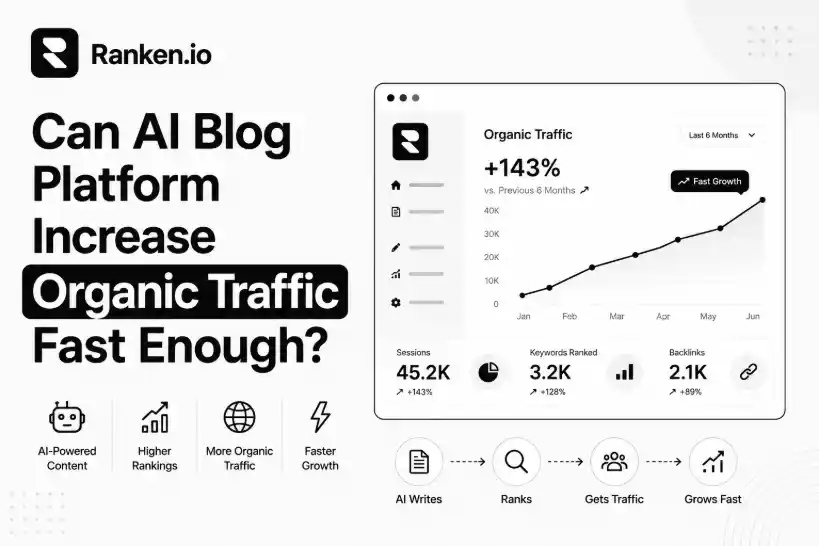
Ranken.io is a modern blogging platform built with Next.js 15 that helps businesses create and manage professional sites optimized for the current search landscape. It enables users to launch a fully separated, independent blog in about 60 seconds using its AI Agent, which functions like a built-in SEO and GEO expert.
The platform applies many best practices for AI visibility automatically while ensuring users retain complete ownership of their content and data. Your blog runs in its own dedicated environment, and everything can be exported anytime.
How Ranken’s AI Agent Simplifies Setup and Optimization
The AI Agent scans your existing business website (or you describe your niche and goals) and sets up the blog with proper structure, templates, and initial optimizations. It supports targeting specific countries or regions, identifies high-potential topics based on current trends, and generates well-structured articles designed to perform across traditional search and AI tools.
Articles include answer-first formatting, natural schema-ready elements, clear headings, lists, and data-backed sections — all characteristics that support better citation potential. The system helps keep content fresh through scheduled updates and autopilot features, adapting to new ranking signals without requiring users to have deep technical knowledge.

Powerful Features for Engagement and Conversions
Ranken supports easy integration of plugins such as Google Analytics and Google Tag Manager for tracking performance across channels. Users can enhance articles with practical conversion elements like CTA blocks, service highlights, embedded maps, customer reviews, comparison tables, and more.
Three professional templates (Classic, Hero Image, Magazine) provide strong visual foundations that also parse cleanly for AI systems. The Next.js foundation ensures fast loading speeds and solid technical performance out of the box.
Realistic User Perspective: Working with Ranken
Users transitioning from manual setups or older platforms often report noticeable improvements in workflow efficiency. Producing authoritative, GEO-friendly articles becomes faster while maintaining full control. The automatic handling of structure and optimization reduces constant manual tweaks, letting users focus more on strategy and growth.
Compared to traditional self-hosted solutions, the speed, built-in AI assistance, and strong technical foundation make ongoing management simpler. The platform’s separated blog environment and ability to integrate converting elements directly into posts are frequently appreciated.
Comparison: Traditional Blogging vs Next-Gen Platforms
Here’s how approaches compare when targeting strong AI visibility:
Aspect | Traditional Approaches | Ranken.io Approach |
|---|---|---|
Blog Setup Time | Weeks of manual configuration | ~60 seconds with AI Agent |
GEO & Schema Optimization | Requires expert knowledge | Built-in and automatic |
Content Freshness | Manual updates | Autopilot scheduling & AI assistance |
Data Ownership & Separation | Full but higher management effort | Complete ownership in dedicated environment |
Technical Foundation | Varies, often needs maintenance | Strong Next.js performance |
Conversion Tools | Plugin-dependent | Easy CTAs, reviews, maps, etc. |
Further Reading
For more on content generation tools, see our Best AI Blog Writer Tools Comparison 2026.
Business owners may also benefit from How to Improve Affiliate Review Conversions in 2026, which shares tactics that work well alongside AI visibility strategies.
Measuring Success and Iterating in the AI Era
Track traditional metrics (impressions, clicks, sessions) alongside AI-specific signals such as citation frequency and referral traffic from tools like ChatGPT. Many platforms offer insights that support ongoing refinement of topics and structure.
Regularly update top-performing content with fresh data, new examples, or expanded sections. Successful strategies combine strong fundamentals with tools that adapt to changing rules, minimizing the need for constant manual intervention.
Getting Started with AI-Optimized Blogging
The shift toward generative search is established. Businesses that create structured, authoritative, and easily parsable content are better positioned to gain visibility in ChatGPT answers and beyond.
Platforms designed for this environment can lower the barrier significantly. Visit Ranken.io to explore how an AI Agent can help launch and optimize a blog efficiently.
The future favors consistent, clear, and expert publishing. Start building your presence in AI answers by focusing on fundamentals and leveraging tools that handle much of the technical complexity.