An llms.txt generator creates a Markdown file that helps AI systems, coding agents, and retrieval pipelines understand a website’s most important content. The file is served at the domain root as /llms.txt and functions as a curated table of contents rather than a full sitemap.
The format was proposed by Jeremy Howard of Answer.AI in September 2024 and is documented at the official specification site llmstxt.org. By mid-2026 it has been adopted by documentation platforms and technical brands including Cloudflare, Anthropic, Stripe, and Mintlify. At the same time, Google has stated that special AI files are not required for AI Overviews or AI Mode, and independent analyses show that many published files receive little or no traffic from major consumer AI crawlers.
This guide explains how generators work, which tools are useful in 2026, how to avoid common failures, what realistic results look like, and answers the questions people actually ask.
What Is an llms.txt Generator?
An llms.txt generator analyzes a website (via crawl, sitemap, or navigation) and outputs a structured Markdown file. High-quality generators produce both a concise index (llms.txt) and sometimes a fuller version (llms-full.txt) that inlines page content. The best results still require human curation—raw dumps of every URL rarely perform well.
The core structure recommended by the specification is straightforward:
# Site or Project Name> Short neutral summary of what the site does.## Main Documentation- [Getting Started](https://example.com/docs/start): Setup and first steps- [API Reference](https://example.com/docs/api): Endpoint documentation## Optional- [Changelog](https://example.com/changelog): Release notes
Only the H1 is strictly required. Clean link lists under H2 headings and neutral descriptions improve usefulness for agents.
Why Generators Matter
Hand-writing a useful file becomes impractical once a site has dozens of important pages. Generators handle discovery and basic formatting. The remaining work—selecting high-value pages and writing factual descriptions—still determines quality. Guides from sources such as LLM Pulse and Citable consistently stress that curation beats completeness.
For broader content strategy that supports both traditional search and AI visibility, see the practical resources on the Ranken blog.
Useful Generators and Tools in 2026
Several free and commercial options exist:
Ahrefs free generator — informed by analysis of a large sample of domains.
llms-txt.io — generator plus managed refresh options.
Mintlify’s built-in generation for documentation sites already hosted on the platform.
Open-source and API-first tools (including Context.dev and various CLI scripts) for developers who need programmatic control.
After generating a draft, most teams still edit heavily. A focused list of 50–150 strong pages generally outperforms an exhaustive sitemap dump.
Ready to create your own file? Generate a clean starting version with the free tool at ranken.io/tools/llms-txt-generator, then curate before uploading.
Correct Structure and Hosting
Serve the file at the exact root path https://yourdomain.com/llms.txt. Subdirectory placement or unnecessary redirects remain one of the most frequent reasons files are never discovered. Confirm accessibility with a simple request:
curl -I https://yourdomain.com/llms.txt
Expect HTTP 200 and a text/plain or text/markdown content type. The original proposal and practical guides (including Cloudflare’s documentation style notes) emphasize root placement and clean Markdown.
Common Generator and Validation Problems
Even when a file looks correct in a text editor, several issues repeatedly cause problems:
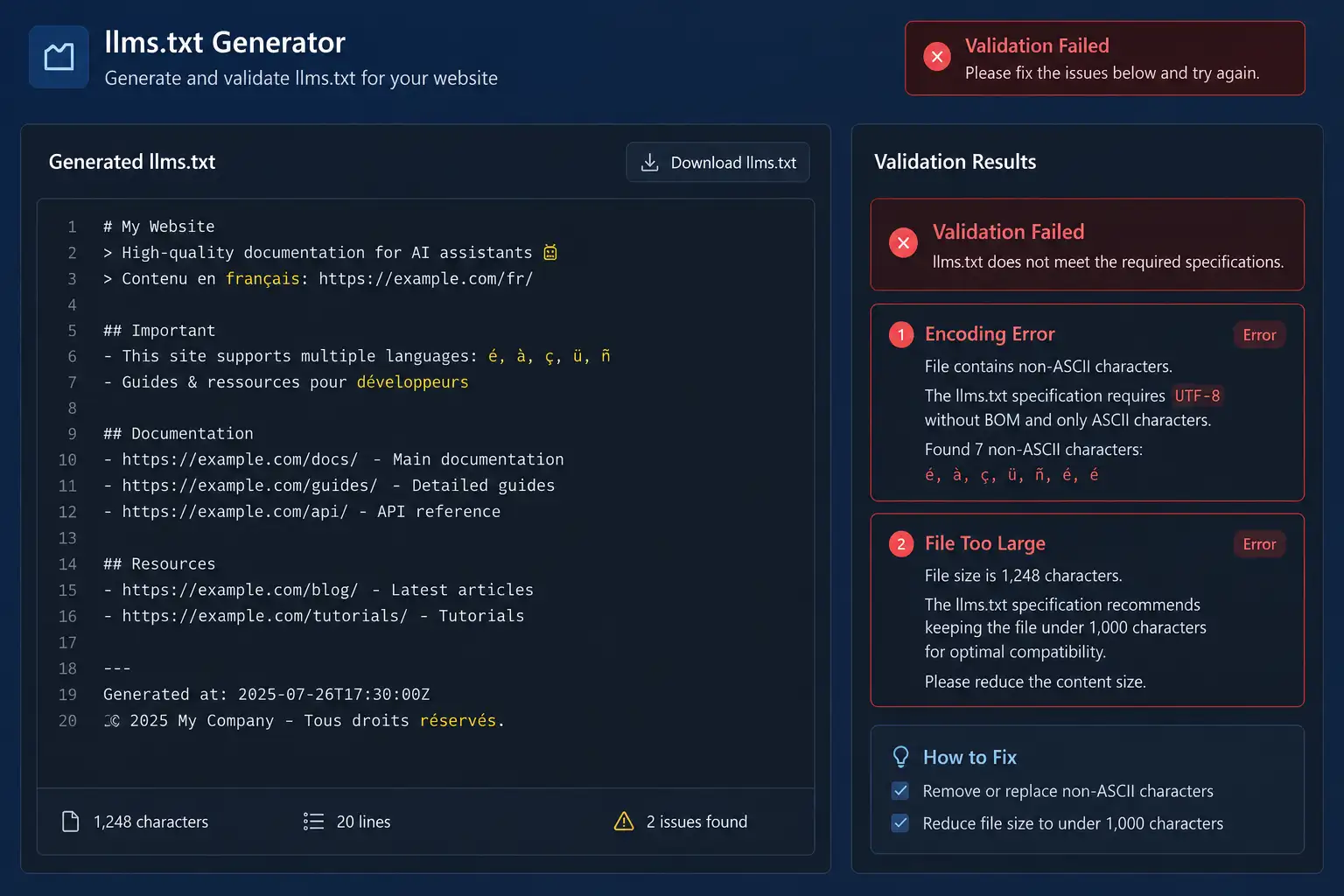
Encoding — non-UTF-8 characters or a byte-order mark can break parsers.
Bloated output — including every archive, tag page, and thin product listing dilutes signal.
Promotional language — descriptions written like marketing copy reduce trust; neutral, factual phrasing works better.
Incorrect location — anything other than the domain root usually fails discovery.
Serving as HTML — the file must be plain text or Markdown, not wrapped in a page template.
These issues align with the practical advice found across independent 2026 analyses and the original specification.
Curation Versus Full Sitemap
llms.txt is not a sitemap replacement. Sitemaps help search engines discover URLs; an llms.txt file gives language models a prioritized, readable map of the content that best represents the site. Internal linking strategy also plays a role in overall discoverability—see the Ranken guide on effective linking for complementary practices.
Does the File Actually Improve Visibility in 2026?
Evidence is mixed and context-dependent.
Clearer value appears for:
AI coding agents and IDE tools (Cursor, Claude Code, and similar systems)
Documentation platforms and custom agent or RAG pipelines that deliberately look for the file
Sites that want to control the narrative when a model is given their domain as context
Limited or unconfirmed value for:
Consumer ChatGPT Search and standard ChatGPT answers (no public confirmation from OpenAI)
Perplexity and Claude consumer search products
Google AI Overviews and AI Mode (Google has stated that special AI files are not required)
Google’s guidance and independent studies (including large-scale domain analyses reported in 2026) indicate that many published files receive little crawler attention. The pragmatic approach is therefore low-cost adoption where the effort is small—especially for documentation or developer-focused sites—while prioritizing strong content, clear structure, and traditional technical SEO.
Additional perspective is available in the original proposal at llmstxt.org, Cloudflare’s notes on AI-consumable documentation, and 2026 reporting from sources such as Search Engine Land and independent AEO practitioners.
Update Frequency
Most sites benefit from reviewing the file quarterly or after major content launches. Documentation-heavy properties may regenerate more often. When new authoritative pages go live, update the list so agents receive the current high-value set. For ongoing content systems that keep pages fresh, explore the automation approaches discussed on the Ranken blog.
Frequently Asked Questions
What is an llms.txt generator?
A tool that produces a Markdown file summarizing a site’s key pages for AI systems and agents. The output still requires curation for best results.
Why does a generated file fail or get ignored?
Typical causes include placement outside the domain root, encoding problems, overly long or promotional descriptions, and serving the content as HTML instead of plain text.
Should every page from the sitemap be included?
No. Select only the strongest, most authoritative pages. Exhaustive lists reduce clarity for models with limited context windows.
Should product pages be listed?
Only when they contain substantial unique content and clear topical authority. Thin listing pages are usually better left out.
How can the file’s placement be verified?
Request https://yourdomain.com/llms.txt directly and confirm a 200 response with the correct content type and no redirect chain.
Is keyword stuffing allowed in descriptions?
No. Neutral, factual language performs better and avoids the appearance of spam.
Do ChatGPT, Claude, or Perplexity use the file?
There is no public confirmation that the major consumer products rely on it for answering queries. Stronger evidence exists for coding agents and documentation-focused tools.
Does Google use llms.txt?
Google has stated that special AI files are not required for its generative search features and that the files do not affect rankings.
Where can a clean starting file be generated?
Use a free generator, review and curate the output, then host the finished file at the domain root. One convenient option is available at ranken.io/tools/llms-txt-generator.
A well-curated llms.txt file remains a low-effort way to improve machine readability for agents and documentation tools. Combine it with strong content, clear internal linking, and solid technical foundations for the best overall results in both traditional search and emerging AI surfaces.