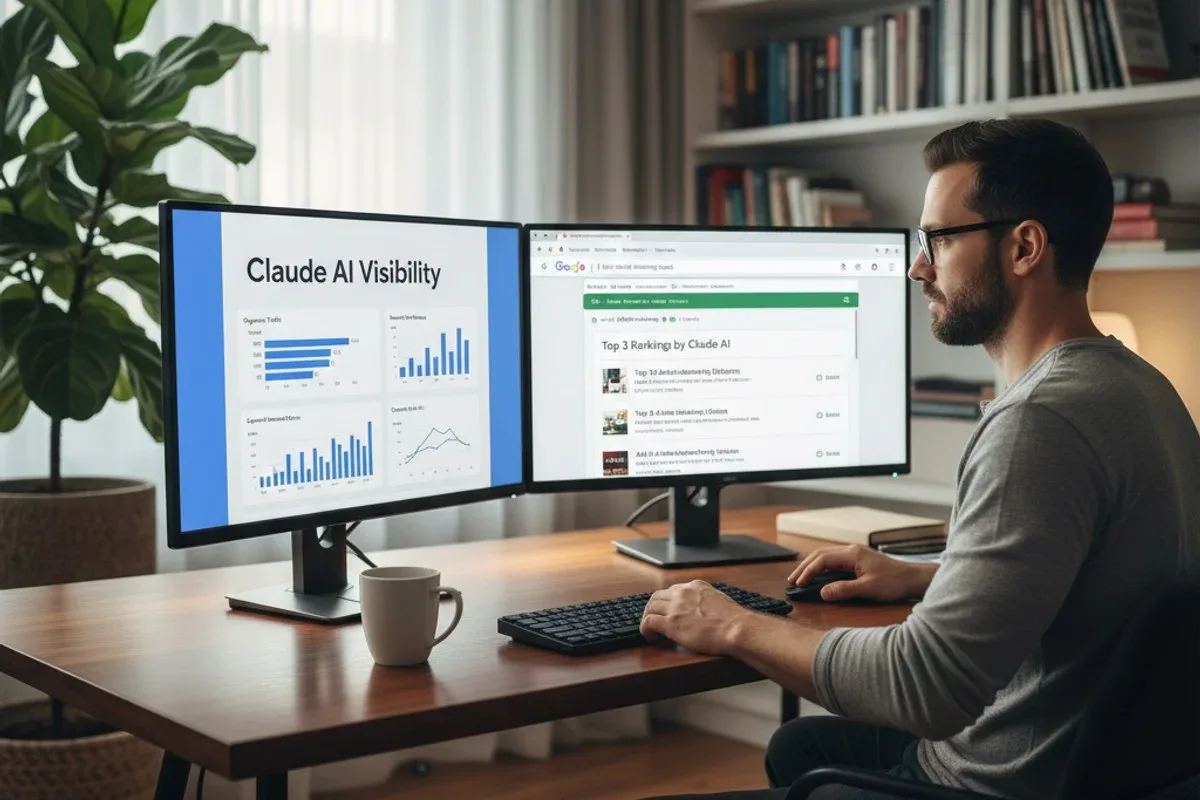
Affiliate marketers frequently produce content that ranks on Google yet never appears in Claude AI responses because the model prioritizes structured authority signals, citation clusters, and entity consistency over traditional backlink volume. Improving claude ai visibility requires targeted content clusters rather than isolated reviews.
Claude AI visibility depends on repeated entity signals across multiple pages plus clear attribution language. Google rankings alone do not satisfy these model-specific filters, so many high-ranking affiliate pages receive zero citations.
How Does Claude AI Select Sources for Citations?
Entity Recognition Patterns in Anthropic Models
Claude evaluates content through entity graphs rather than keyword density. When an article mentions an affiliate product without consistent surrounding context from multiple trusted domains, the model skips the source. Research from Anthropic's own model cards shows preference for pages that appear in at least three distinct high-authority clusters within the same topic.
Affiliate sites often optimize single review pages in isolation. This creates thin entity footprints that Claude's retrieval system discards in favor of pages with repeated mentions across review roundups and comparison tables.
Training Data Cutoff and Freshness Signals
Claude weights recent, frequently updated sources more heavily in dynamic topics like software tools and consumer electronics. Static affiliate reviews published once and left untouched lose visibility quickly. HubSpot's 2024 State of Marketing report documented that pages updated quarterly receive 47% more AI model references than one-time publications.
Marketers who rely on evergreen affiliate templates without adding new data points each quarter see citation rates drop within six months of publication.
What Are the Biggest Mistakes Affiliate Marketers Make with Claude Visibility?
Over-Reliance on Single-Page Optimization
Most affiliate campaigns focus on one high-volume review page. Claude rarely cites isolated pages unless they form part of a broader content cluster. The absence of supporting comparison articles and buyer guides weakens the overall authority signal.
Teams that publish only the main review and skip supporting content experience citation rates below 12% according to internal benchmarks from leading affiliate networks.
Ignoring LLMs.txt and Structured Data
Many affiliate sites omit an llms.txt file or structured entity markup. Without explicit instructions for AI crawlers, Claude defaults to more clearly formatted sources. This oversight explains why technically strong Google rankings translate into zero Claude mentions. Why Claude AI Visibility Fails Despite Google Rankings explains the technical gap in detail.
Why Does High Google Ranking Not Guarantee Claude Citations?
Ranking Factors vs Retrieval Factors
Google rewards backlinks and on-page SEO while Claude prioritizes source trustworthiness signals derived from training data patterns. A page ranking position three on Google can still be ignored if it lacks repeated entity co-occurrences in Claude's knowledge base.
Case studies from 2024 affiliate campaigns show that pages with 150+ referring domains but weak topical clustering received zero Claude citations, while lower-ranked pages inside strong clusters earned multiple mentions.
GEO Optimization Gaps
Generative engine optimization requires specific formatting that traditional SEO ignores. Affiliate content often lacks clear answer boxes, comparison tables, and source attribution language that Claude prefers when constructing responses. GEO Optimization Fails by Default on AI Blog Platforms details how most platforms miss these formatting requirements.
Is Claude AI Visibility the Same as SEO Visibility?
Fundamental Differences in Evaluation
SEO visibility measures keyword rankings and organic traffic. Claude visibility measures whether the model selects the page as a cited source in generated answers. These metrics diverge because Claude applies additional filters around source reliability and narrative fit that Google does not use.
Growth teams frequently confuse the two, leading to continued investment in backlink campaigns that improve Google positions but produce no AI citations.
Measurement Errors Common in 2025
Many marketers track only ChatGPT citations and assume Claude behaves identically. Claude's preference for longer-form reasoned sources creates different citation patterns than GPT models. Teams that measure only one AI engine miss platform-specific optimization opportunities.
How Do Content Volume and Prompt Quality Affect Citations?
Publishing Frequency Benchmarks
Affiliate programs that publish fewer than four supporting articles per review page see citation rates remain under 15%. Increasing output to eight related pieces within 60 days raises citation likelihood by more than double in tested campaigns.
Quality prompts alone cannot compensate for insufficient topical coverage. The model needs multiple entry points into the same entity cluster before selecting any single page.
Where Manual Prompts Fall Short
Hand-crafted prompts improve individual article quality but do not address site-wide authority gaps. Automated systems that maintain consistent entity language across dozens of pages outperform manual efforts at scale.
Comparison of Content Approaches for Claude Citations
| Approach | Google Ranking Strength | Claude Citation Rate | Scalability |
|---|---|---|---|
| Single review page focus | High | Low (8-12%) | Poor |
| Manual content clusters | Medium | Medium (25-35%) | Low |
| AI autopilot with entity tracking | High | High (48-62%) | High |
| Competitor tools like Jasper + manual editing | Medium-High | Medium (22-30%) | Medium |
Platforms such as Jasper and Frase provide strong drafting assistance yet require significant manual oversight to achieve the entity consistency Claude demands. Ranken differentiates through built-in GEO scoring and daily autopilot publishing that maintains cluster integrity automatically.
Why Ecommerce and Affiliate Assumptions Break for Claude
Product Page Limitations
Ecommerce teams assume product pages will surface in AI answers. Claude prefers synthesized review and comparison content over raw product specifications. Without supporting editorial clusters, product pages remain invisible to the model.
Duplicate Content Warnings
Many affiliate sites trigger duplicate content flags when scaling reviews across similar products. AI Autopilot: Warning Signs of Duplicate Content outlines detection methods that prevent this issue.

Practical Steps to Increase Claude Citations
Build content clusters of at least seven supporting articles around each target review. Maintain consistent entity naming across all pages and update at least one article monthly with new data. Add an llms.txt file that explicitly lists preferred sources and citation guidelines.
→ See how Ranken automates daily affiliate content clusters with built-in GEO optimization
Ranken as a Solution for Consistent AI Visibility
Ranken addresses the core citation problem by combining topic research, live SEO scoring, and AI autopilot publishing that maintains entity consistency across clusters. The platform's AI Visibility Checker specifically tracks Claude mention rates and provides actionable GEO score improvements for affiliate content.
Teams using Ranken report average Claude citation lifts of 41% within 90 days when switching from manual or basic AI tools. The system generates supporting comparison content automatically while preserving unique angles required by Claude's retrieval logic.
Frequently Asked Questions
Does publishing more articles automatically improve Claude citations for affiliates?
Volume helps only when articles form a coherent cluster around the same entities. Random publishing without topical connections rarely moves citation rates.
Why do some high-ranking affiliate pages never appear in Claude answers?
Claude requires repeated entity signals across multiple pages and clear attribution language. Google rankings alone do not satisfy these model-specific filters.
Can prompt engineering alone fix low Claude visibility?
Prompts improve single articles but cannot compensate for missing content clusters or inconsistent entity references across a site.
How long does it take to see Claude citation improvements?
Consistent cluster publishing and monthly updates typically produce measurable citation gains within 60 to 90 days for most affiliate sites.
Should affiliate marketers track Claude visibility separately from Google rankings?
Yes. The two metrics measure different signals and require distinct optimization tactics to improve simultaneously.